Rate limits
The gateway enforces requests-per-minute (RPM), tokens-per-minute (TPM), and request burst after tenant auth and before cache, failover, or upstream calls. Policies bind to an organization or API key, and optionally to a model.
Pair with product Guardrails for agent-level budgets and breakers. Dollar spend caps are not enforced yet—use RPM/TPM for hard stops today.
When it applies
| Path | Guardrails rate limit? |
|---|---|
/gateway/v1/chat/completions, /completions, /responses, /embeddings | Yes |
| Capability proxies (images, audio, video) | Yes (when policy effective) |
/gateway/cursor/... chat | Yes |
Passthrough /gateway/{provider}/... | Yes (subject + defaults; model peeked when body present) |
A gateway-enforced 429 is terminal—it never enters the failover engine. Upstream provider 429s remain failover-retryable.
Console setup
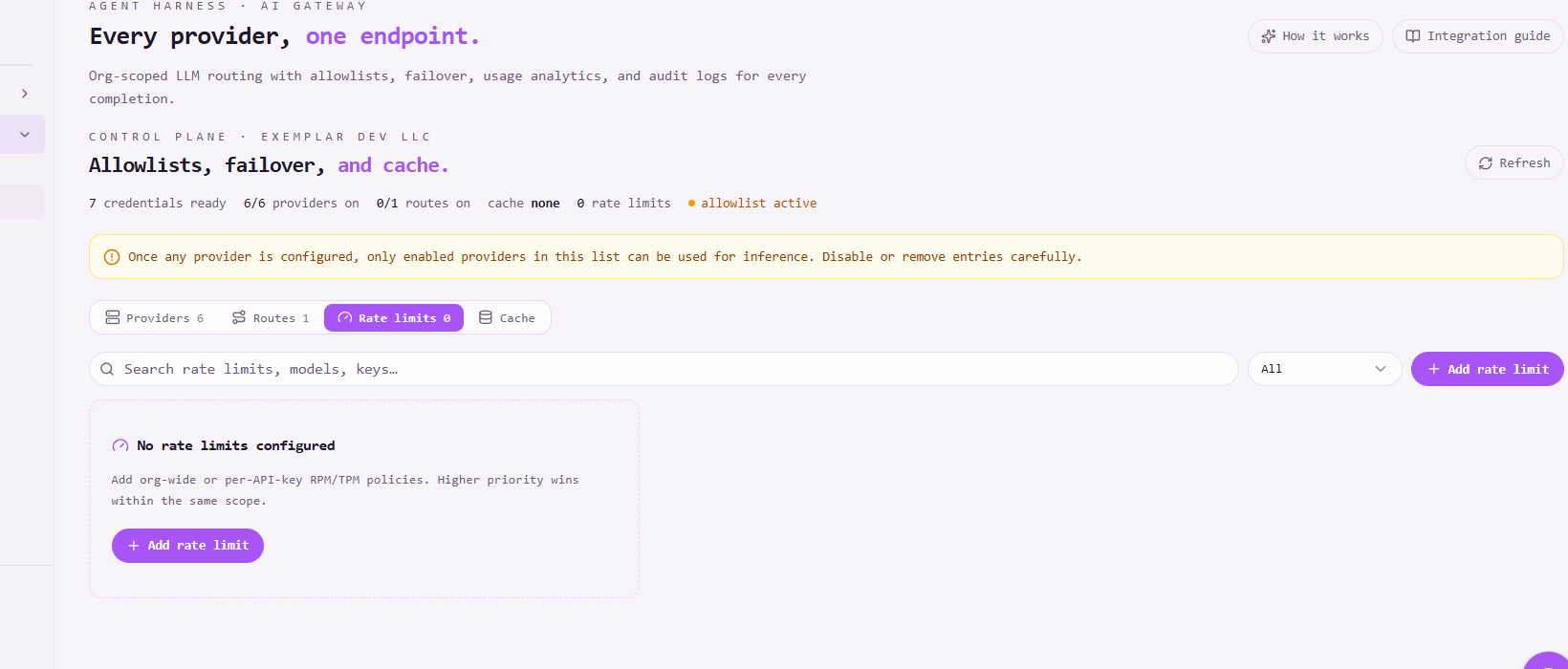
Open AI Gateway → Management → Rate limits.
The Management header shows how many policies are active (for example 0 rate limits).
Open the Rate limits tab
Switch to Rate limits. If none exist yet, you see an empty state with + Add rate limit.
Add a policy
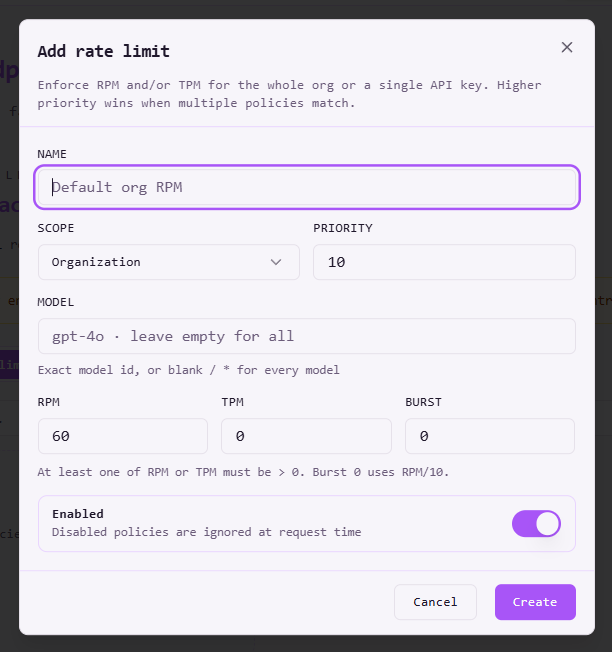
Click + Add rate limit. Fill in:
| Field | What to set |
|---|---|
| Name | Friendly label (e.g. Default org RPM) |
| Scope | Organization (org-wide) or a single API key |
| Priority | Higher wins when several policies match the same scope |
| Model | Exact model id, or blank / * for every model |
| RPM | Requests per minute (0 = off for this metric) |
| TPM | Tokens per minute (0 = off for this metric) |
| Burst | Extra request allowance; 0 → default RPM/10 |
| Enabled | Off policies are ignored at request time |
At least one of RPM or TPM must be greater than 0.
Create and verify
Click Create. Send a Chat Completions request and inspect X-RateLimit-* response headers. When you exceed the limit, expect 429 with Retry-After—failover will not switch providers.
Creating and editing rate limits requires an admin role in the org.
Admission rules
| Check | Behavior |
|---|---|
| RPM | Consume 1 request; window max ≈ RPM + burst (burst defaults to RPM/10, min 1) |
| TPM | Admit if remaining token budget in the current sliding window is > 0; tokens are added after the response from actual usage (JSON or SSE) |
Trade-off: The last admitted request under TPM can overshoot the budget by its own usage; subsequent requests are blocked until the window slides. Gateway response cache hits skip TPM debit.
Client-visible contract
On allow (when RPM and/or TPM apply):
X-RateLimit-Limit-Requests/X-RateLimit-Remaining-Requests(if RPM > 0)X-RateLimit-Limit-Tokens/X-RateLimit-Remaining-Tokens(if TPM > 0)
On deny:
| Field | Value |
|---|---|
| Status | 429 |
| Body | {"error":"rate limit exceeded: requests per minute"} or ...tokens per minute |
Retry-After | Seconds until approximate window relief |
| Remaining headers | Set to 0 where applicable |
# Example: inspect rate-limit headers on a successful call
curl -D - -o /dev/null https://production-api.exemplar.dev/gateway/v1/chat/completions \
  -H "Authorization: Bearer $EXEMPLAR_API_KEY" \
  -H "Content-Type: application/json" \
  -d '{
    "model": "openai/gpt-4o-mini",
    "messages": [{"role": "user", "content": "ping"}]
  }'
# Look for: X-RateLimit-Limit-Requests, X-RateLimit-Remaining-Requests, …
Policy resolution
Precedence (most specific wins):
- API key + exact model
- API key + all models (
*/ empty) - Organization + exact model
- Organization + all models
- Platform defaults
Within a tier, higher priority (from the Console policy) wins.
Guidelines
- Start with an org-wide RPM in Management → Rate limits; add TPM when you need token budget control.
- Prefer API-key + model policies for expensive models (
openai/gpt-4o, large Claude variants). - Treat gateway 429 as a client retry-after-window signal—do not expect failover to another provider.
- Expect one-request TPM overshoot; size budgets with that in mind.
Daily / monthly dollar spend caps are out of scope for enforcement today. Use RPM/TPM for hard stops.
Related
- Failover & routes — runs only after admission
- Guardrails — agent budgets and circuit breakers
- Response cache — hits skip TPM debit